

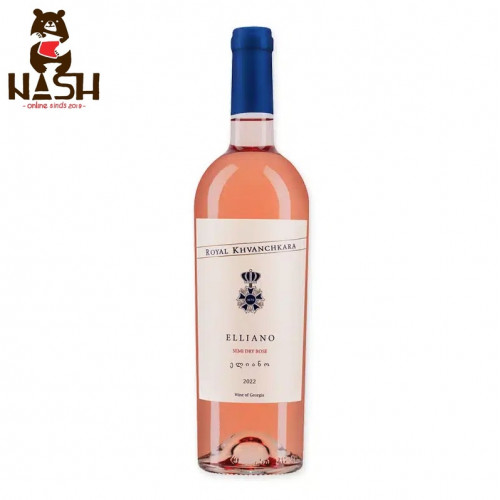
- Stock: 2
- Model: 4860001320455
A semi-dry rosé from Racha-Lechkhumi, made at the legendary Royal Khvanchkara winery by the team of Lado Uzunashvili (an 11th-generation winemaker with international experience (France, Japan, Australia) and David Iselidze). Elliano is made by blending white and red wines—95% dry Tsolikouri (white) and 5% red Alexandrouli, blended as finished wines. This "Champagne rosé method" applied to still wine is a rare technique; in most European PDOs, it is prohibited for still rosés. In Georgia, it is permitted at the regional level, and here it produces a surprisingly precise result: the color, acidity, and fruit profile are controlled more precisely than with classic saignée or direct press. For a Dutch wine geek, this is a real draw.
Grapes:
- Tsolikouri (95%) is the main white grape indigenous to western Georgia. It produces wines with citrus freshness (grapefruit, lemon zest), notes of apple, pear, white flower, and noticeable minerality. The same variety is behind the famous semi-sweet Tvishi from the neighboring region
- Alexandrouli (5%) is a native red rosé from Racha. It imparts petal aromas (rose, violet), hints of red berries (strawberry, cranberry, cherry), and a silky texture. Here, its role is to color the wine, literally adding aroma. This is a rare pairing for rosé: 19 parts citrusy mountain white rosé to 1 part perfumed native red rosé
Producer: Royal Khvanchkara
Region: Racha-Lechkhumi - northwestern mountainous Georgia, on the southern slopes of the Greater Caucasus, on the right bank of the Rioni River. The Royal Khvanchkara vineyards are located at an altitude of 780–800 meters, on alluvial-rocky soils with a carbonate base. The cool, relatively humid climate and altitude maintain vibrant acidity even in warm years—a terroir rarely associated with rosé, making the result all the more interesting: this is a mountain rosé, not a Mediterranean one
Alcohol: 12.5%
Vinification: A blend of white and red wines. Residual sugars of approximately 8–15 g/l are balanced by the acidity, and on the palate, it feels closer to dry
Color: Pale salmon, with subtle copper-pink highlights—a modern "Provençal pale" shade currently in vogue among Dutch consumers. Upon exposure, it's almost transparent, with a delicate apricot-pink hue
Aroma: Delicate, fresh, with a distinct coolness
- Foreground: wild strawberry, cranberry, red currant, grapefruit zest
- Background: rose petal, acacia, light floral honey
- Mineral base: wet stone, lemon peel—a typical Tsolikouri mountain signature
Taste: The attack is soft but not cloying—a noticeable residual sweetness is immediately captured by the lively, almost lemonade-like acidity of Tsolikouri. The middle is cranberry-strawberry, with citrus freshness and a touch of pepper from Alexandrouli. The finish fades to an almost dry, mineral note, with a pleasant hint of grapefruit zest. This is the signature Dutch flavor pattern: "it seems fruity, but it's not at all sweet in the mouth." The texture is round, without harshness. The length is medium and clean
Food pairings:
This isn't a "drink it and forget it" aperitif—it's a rosé that goes with food, and with a fairly wide palette at that.
- The ideal pairing for NL is Asian cuisine: rijsttafel, nasi goreng, bahmi, satay ayam, suryaman roti, Thai som tam and pad thai, Vietnamese bún bò, and Indian chicken in coconut curry. The semi-dry sugar balances the chili pepper's heat, the acidity of the tsolikouri cuts through the fat, and the low alcohol doesn't further "burn" the tongue. This is the category where Provençal dry rosé gives way to a lesser-known dish.
- Georgian classics: Imeretian khachapuri, lobio, chicken satsivi, light kharcho
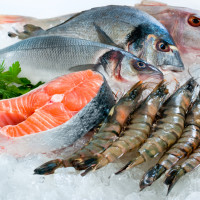
- Fish and seafood: fried sea bass, smoked salmon, grilled tiger prawns, tuna tartare, trout
- Light meats: duck fillet with fruit sauce, Peking duck, Thai salads with beef, turkey with cranberries
- Cheeses: fresh goat chevre, burrata, mozzarella di bufala, delicate brie, feta
- Summer on a Dutch terrace: mussels in white wine, raw bar, quiche lorraine with herbs, prosciutto melon, tartine with figs
- What's NOT suitable: red meat, aged hard cheeses, heavy sauces Red wine, chocolate desserts
Serving:
- Temperature: 8–10°C (the manufacturer states 10–12°C, but for semi-dry rosé, a little colder is better—the acidity will be brighter and the sugars won't "jump out")
- Glass: a general-purpose white wine glass with a tapered top or a special rosé glass. Avoid a flat "coupe"—the aroma will be lost
- Decanting: Not necessary
- When to drink: Now and within 1–2 years of vintage. Rosé is not for storage—drink it young and fresh
- Opened bottle: It will keep in the refrigerator, corked, for 2–3 days without losing its quality
| Specifications | |
| Country | Georgia |
%20(1)-288x288h.jpg "Moldovan red dry biodynamic wine Equinox Trei Crai with organic certificate")
-288x288h.png "Moldovan red dry wine Carlevana Malbec Raritet")